
THE INVISIBLE WORKLOAD: UNDERSTANDING EMOTIONAL LABOR IN YOUR RELATIONSHIP
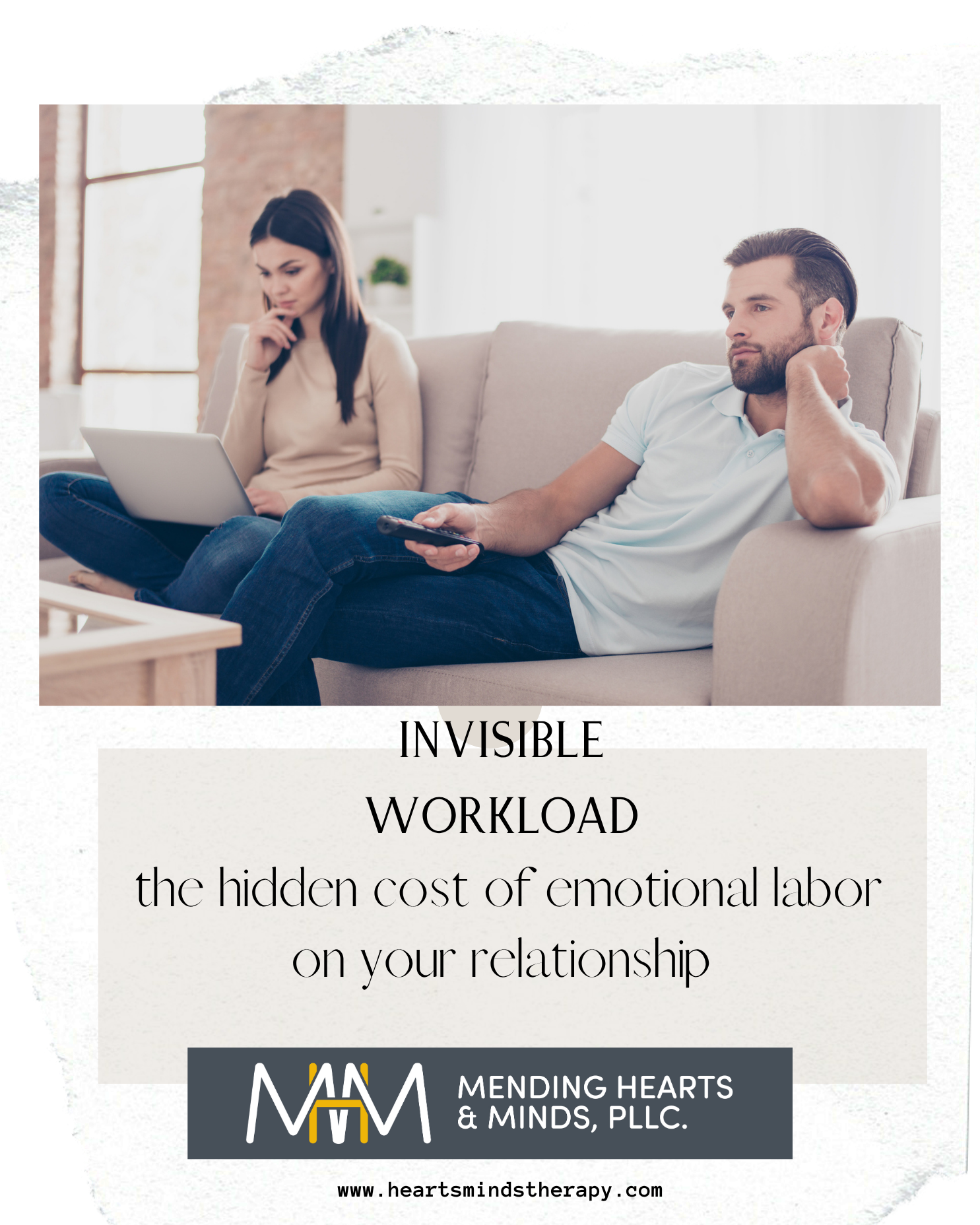
It’s 9:47 on a Tuesday night, and she’s sitting at the kitchen table with 12 mental tab open at the same time: the pediatrician’s appointment she has to remember to make tomorrow morning because Ethan needs a sports physical for travel ball, the school field trip form due Friday, the mother’s day card she has to get for her mother in law, the dishwasher detergent that’s almost gone.
She hasn’t moved in ten minutes, but she is, in every sense that matters, working. Across the room, he’s genuinely relaxed, scrolling his phone, the dishes done, the lawn mowed that afternoon. When she finally says, “I’m exhausted,” he looks up, confused, even a little hurt. “I helped today,” he says. “I did the dishes.” , “I would have done more if you asked. Why didn’t you ask me to do some of your things?” They are both telling the truth. They are simply describing two entirely different kinds of work — one that ends when the task is finished, and one that never quite turns off.
This is one of the most common dynamics we see in couples counseling, and it rarely gets named correctly. The term for what's missing is emotional labor — and understanding it can change the entire conversation a couple is having about fairness, partnership, and care.
What Emotional Labor Actually Means
The phrase “emotional labor” was coined by sociologist Arlie Hochschild in the 1980s to describe the work of managing one's own feelings to meet the emotional expectations of a job — think of a flight attendant who has to stay warm and patient no matter how a passenger treats them. Over time, the term migrated into everyday language and broadened to describe something related but distinct: the unpaid, often invisible mental and emotional effort of managing a household and a relationship.
In this everyday sense, emotional labor includes things like:
Anticipating what needs to happen before it needs to happen (noticing the school form is due, remembering a parent's anniversary is coming up)
Monitoring the emotional climate of the family relationships and stepping in to repair it
Holding the mental list of everyone's needs — partner, kids, extended family
Managing your own reactions so conflict doesn't escalate (i.e. working to figure out how to get your needs met without causing conflict)
Doing the planning and coordinating that makes family life run, even when someone else executes the task
The key distinction couples often miss is the difference between doing a task and managing the awareness that the task exists. Loading the dishwasher is a task. Noticing the dishwasher needs to be run, remembering to buy more detergent, and tracking whether everyone's morning schedules will allow time for it — that's the labor underneath the labor.
Why This Becomes a Source of Conflict
In our work with couples, emotional labor rarely shows up as its own topic. It shows up disguised as other arguments:
“You never think ahead.” One partner feels like they're always the one solving problems before they become urgent, while the other only engages once something has already gone wrong.
“I don’t feel like you are with me in this. I feel like I don’t have a partner really.” One person is doing the noticing, planning, and reminding, while the other is doing the executing — and only when reminded.
“I can't relax, even when I'm not doing anything.” This is often the clearest sign of an emotional labor imbalance. One partner's nervous system stays on alert, scanning for what needs attention, even during downtime.
“I said I'd help if you just told me what to do.” This well-intentioned offer can actually add to the imbalance, because it keeps the planning and delegating — the cognitive part of the labor — on one person's plate.
These conflicts often escalate because the partner carrying more emotional labor doesn't just feel tired — they can feel unseen. And the partner being asked to do more often often feels criticized for being “lazy” which is confusing because from their perspective, they genuinely don't see what's missing. That gap in perception is usually the real problem, not a lack of love or effort.
A Note on Fairness, Not Blame
It's worth saying clearly: an imbalance in emotional labor is not usually anyone's fault so much as it a pattern that has been established gradually in the relationship. It is often shaped by habit, by family-of-origin patterns, by who happened to take charge of something once and kept doing it, or by broader cultural expectations about who is “supposed to” notice and manage relational and household needs. Couples counseling isn't about assigning blame for how the imbalance started — it's about helping both partners see the pattern clearly enough to change it together.
Why "Who Does More Chores" is the Wrong Argument
Many couples arrive in our office already fighting about chores — who does the laundry more often, is folding the clothes and putting them away for the younger kids part of doing the laundry? Who cooks the meals on which days?. It's an easy argument to have because it's concrete and countable. You can literally tally who did what. The problem often is though- who notices the laundry needs doing? Who remembers that Ethan has ball tomorrow and his uniform needs to be clean? Who does the meal planning, and figures out how to get the kids fed before ball practice? In other words, the tally is exactly why it tends to go wrong. A person taking over the task doesn’t solve the problem if the labor of noticing what needs done always falls on one person. A chore chart can resolve a logistics problem, but it can't touch the feeling underneath it.
When the conversation stays at the level of tasks, it turns into a kind of accounting dispute — each partner keeping a private ledger, ready to produce evidence. "I did the dishes three times this week." "Well, I did the laundry, the groceries, and I scheduled the dentist." Both partners walk away feeling unappreciated, and neither one feels closer to the other. There really is no winning that argument, even if you agree on who did what, you lose the connection. That's the tell that something deeper is being missed: the argument isn't really about the dishes. It's about wanting to feel noticed, supported, and like a true partner in carrying the weight of a shared life — and a chore chart was never built to answer that.
In session, we often help couples slow down and ask a different question than "who does more?" — something closer to, "What does truly taking this off your plate look like?" or "What are you actually hoping to feel when you ask me for help?" “What do you really need from me when have a conversation about chores. Underneath most chore arguments is a bid for partnership: that you're seen, that you're not carrying this alone, that your partner can see when you are drowning, they are paying attention to your life even when you haven't said anything out loud. Naming that need directly, instead of relitigating the dishwasher, is usually what finally moves the conversation forward.
How Couples Can Begin to Rebalance It
Name it specifically. “You don't help enough” is hard to act on. “I'm the only one who tracks our social calendar and remembers birthdays” is something a partner can actually take ownership of.
Make the invisible visible. Many couples find it useful to sit down and simply list out everything that goes into running their household and relationship — not just chores, but the noticing, planning, and emotional check-ins. Seeing the full list together is often the first moment of real clarity for both partners.
Transfer full ownership, not just tasks. True rebalancing means one partner takes over the entire arc of a responsibility — noticing it, planning it, and doing it — rather than just executing on command. A partner who has to be told what to do hasn't taken the labor off anyone's plate; they've just added a task to the other person's list of things to delegate.
Check in regularly, not just during conflict. Emotional labor shifts over time — a new job, a new baby, aging parents. What was balanced a year ago may not be balanced now. Brief, regular check-ins prevent resentment from building silently.
Get curious instead of defensive. If your partner says they're carrying more of this invisible work, the most productive first response is curiosity — “Help me understand what that looks like day to day” — rather than immediately listing what you already do.
Why This Matters for Long-Term Relationship Health
Left unaddressed, an emotional labor imbalance tends to erode intimacy and trust. The partner doing more of the invisible work often experiences a quiet, accumulating exhaustion that can look like irritability, withdrawal, or a loss of desire — not because the relationship lacks love, but because one person is depleted in a way the other doesn't fully see. The partner doing less may sense the distance growing without understanding why, since from their vantage point, things seem fine.
In our practice, helping couples name and rebalance emotional labor is often one of the most relieving conversations they have — not because it's easy, but because for the first time, both partners are finally talking about the same thing.
If this pattern sounds familiar in your relationship, you're not alone — and it's a common, workable issue in couples counseling. Reach out to schedule a session to start the conversation together.
[/et_pb_text][/et_pb_column][/et_pb_row][/et_pb_section]