

BLOG
Your helping hand.

Anxious Attachment: When Love Comes with a Constant Question Mark
Anxious attachment describes a way of relating where the longing for closeness comes with a steady undercurrent of worry and anxiety. Your love for your partner runs deep, and so does your fear of losing them. Your attachment system stays on alert, scanning for any sign that the connection may be slipping.
The Anxious-Avoidant Dance: Why You Keep Stepping on Each Other’s Toes
Have ever felt like you and your partner keep having the same fight with different words? If so, you may be caught in one of the most common patterns we see in couples therapy. One partner reaches, the other steps back. The reaching gets louder, the stepping back gets farther. We call it the anxious-avoidant dance.

Avoidant Attachment: When Closeness Feels Like Too Much
Some people feel most at ease when they can handle things on their own. When emotions run high, they go inward. When a partner wants to talk about the relationship, they feel a strong pull to change the subject or find something that needs doing. If that sounds familiar, you may lean toward what we call avoidant attachment.
Attachment Styles: Understanding Your Model of Love
First of our series on attachment styles, and the impact of attachment styles on couples relationships.
Differentiation in Relationships: How Trauma Makes It Hard to Be Close and Stay Yourself
Trauma teaches the nervous system, and it doesn't take one catastrophic event to do it. Therapists use the term "little t" trauma for experiences like emotional neglect, emotional abandonment, or being shamed again and again for certain feelings as a child. These experiences teach the nervous system something profound about connection: connection is not safe. Your responses to your partner make sense. They are the ways you learned to survive disconnection, either by enmeshing with someone to stay safe or by hunkering down inside yourself to stay safe. They protected you once, but in your relationship today they may be getting in the way.

Pivot! What a Stuck Couch Can Teach Us About Your Negative Relationship Cycle
If you’ve seen the Friends episode known as “The One With the Cop,” you remember the scene. Ross, Rachel, and Chandler are hauling a new couch up a narrow stairwell. The turn is tight. Ross, growing more anxious, starts shouting one word over and over: “Pivot!”https://www.youtube.com/watch?v=L_PWbnHABsM
It’s funny because we recognize it. Most couples have had their own stairwell moment: two people stuck in a tight space, one pushing harder, the other shutting down or snapping back, and the thing they’re both trying to carry going nowhere.
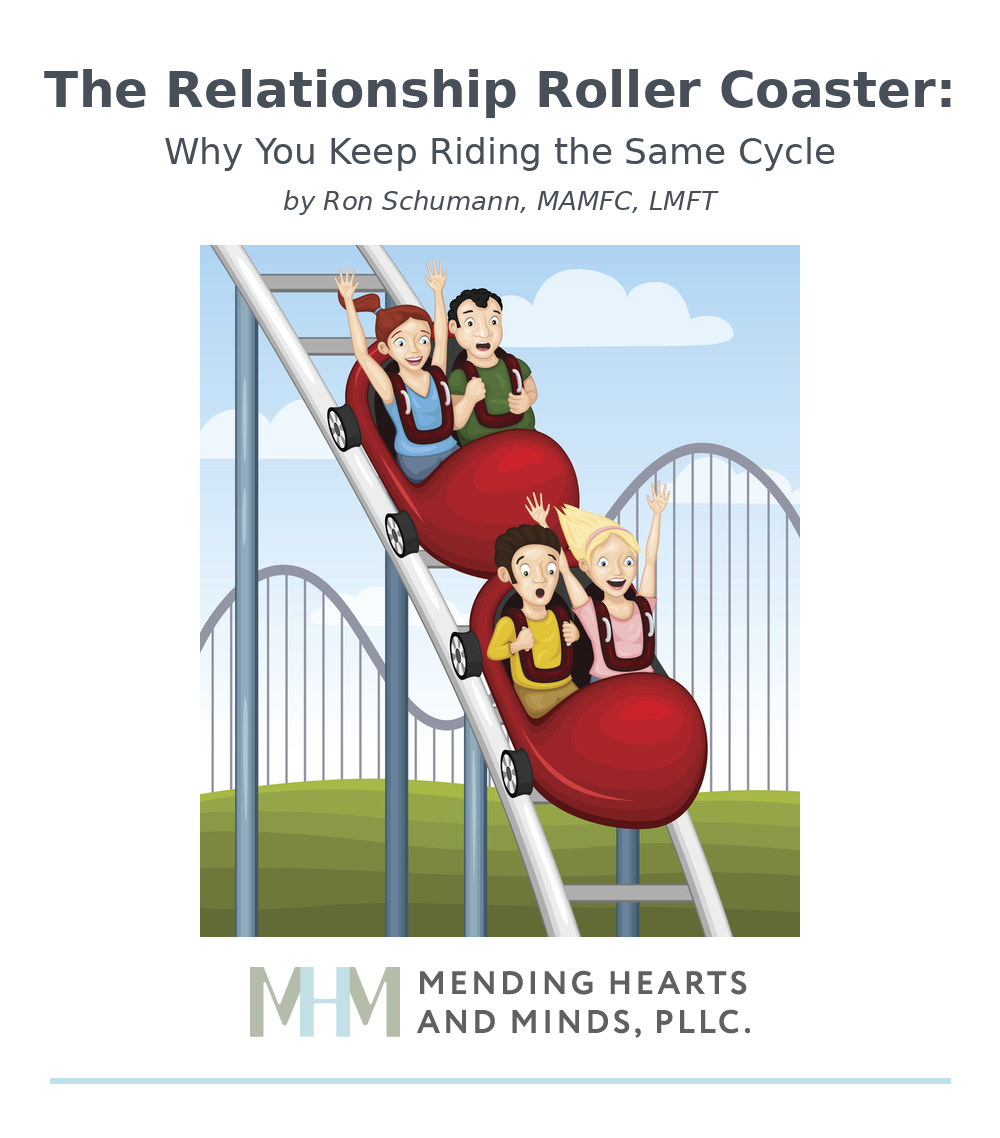
The Relationship Roller Coaster
Round and round we go. When it’s good, it’s the most amazing roller coaster you could ride. When it’s not, it’s a nightmare you can’t wake up from.
If your relationship feels like this, you may be asking yourself why you keep ending up in the same fight. You know the script by heart. One of you pushes, and the other pulls away. Voices rise, or the room goes silent. Eventually things calm down, and you both promise to do better. Then, days or weeks later, you’re back in line for the same ride.
In couple’s therapy using Emotionally Focused Therapy (EFT), we call this the negative cycle. The most important thing to understand is this: the cycle is the problem, not your partner and not you.

Why Small Mistakes Feel So Big: Shame, Guilt and Marriage
Shame, Guilt and MarrIage
Guilt and shame both feel bad, and people often use the words interchangeably. Or sometimes they draw a distinction between guilt, shame and toxic shame. Psychologists who study guilt and shame, though, draw a clear line between them.
Guilt is about what you did. It focuses on a specific action and its effect on someone else. “I forgot to call the plumber, and now Dana has to deal with the leak another day.”
Shame is about who you are. It takes a single action and turns it into a judgment about your whole self. “I forgot again. I’m unreliable. I’m a disappointment.”

The Scar Tissue in Our Relationships
The Scar Tissue in Our Relationships: What Physical Therapy Taught Me About Emotionally Focused Couples Therapy

When Love Looks Like Anger
In Emotionally Focused Therapy, we talk about primary and secondary emotions. The secondary emotion is the one that shows up first, the one you can see — in this case, you might believe she is angry. Fists on a chest.

Same Fight, Every Sunday
As a couples therapist, the couples with perpetual problems and gridlocked problems are the ones I tend to see in my office. Sometimes the conflict isn't totally gridlocked yet, but both partners can see it heading that way. Problems become gridlocked because as humans we tend to focus on finding a solution rather than finding a way to talk about the problem.

What Nobody Tells You About Blending A Family
What Nobody Tells You About Blending a Family
As family therapists and marriage counselors, we get calls almost every week from couples trying to merge two households into one. Different kids, different pets, different rules, different histories, all under one roof, while the couple is also trying to build a brand-new marriage at the same time. It's an enormous amount to manage.


FINDING YOUR WAY THROUGH GRIEF
Grief and loss touch every corner of human experience. They are no respecter of age, gender, race, culture, or circumstance — and yet, grief has a way of making us feel profoundly alone.


