
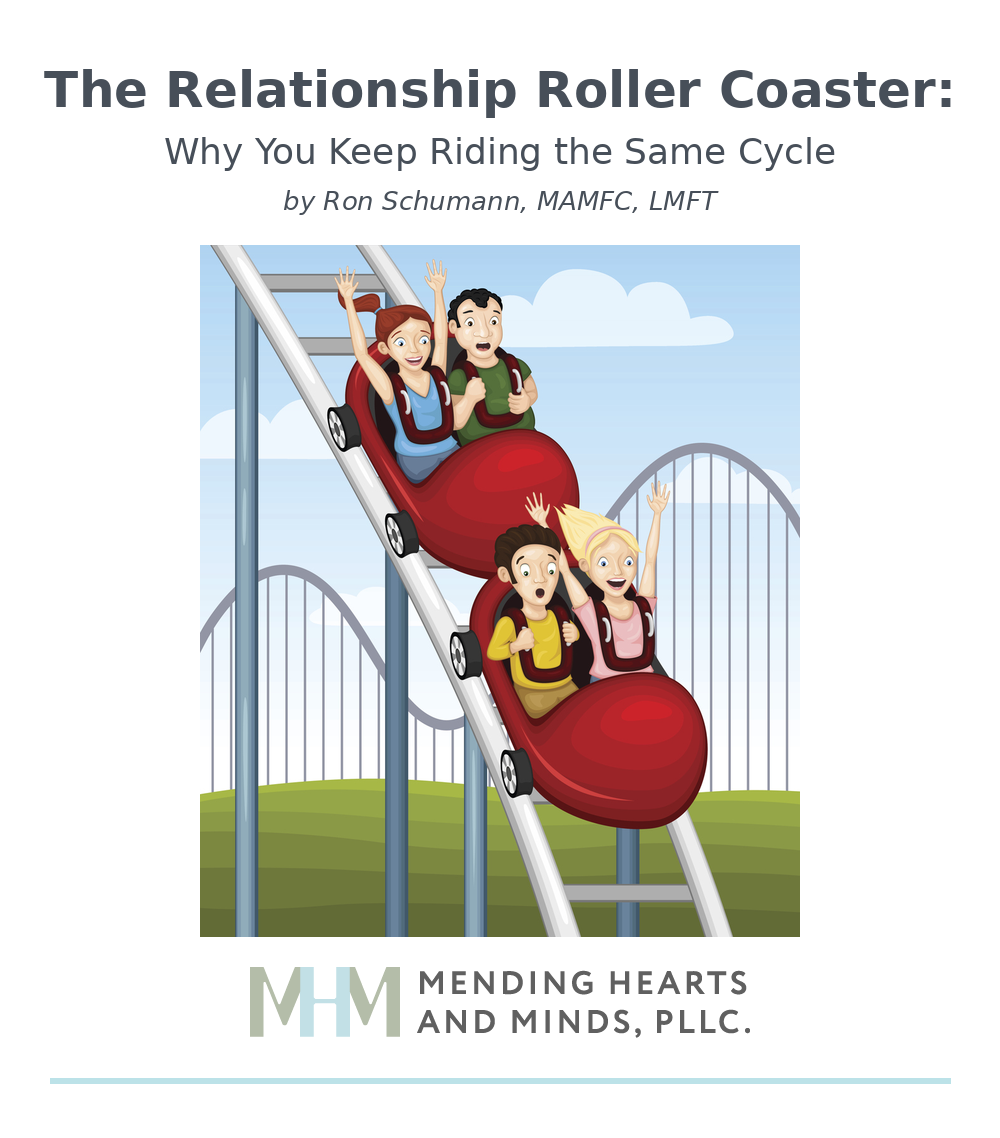
Round and round we go. When it’s good, it’s the most amazing roller coaster you could ride. When it’s not, it’s a nightmare you can’t wake up from.
If your relationship feels like this, you may be asking yourself why you keep ending up in the same fight. You know the script by heart. One of you pushes, and the other pulls away. Voices rise, or the room goes silent. Eventually things calm down, and you both promise to do better. Then, days or weeks later, you’re back in line for the same ride.
In couple’s therapy using Emotionally Focused Therapy (EFT), we call this the negative cycle. The most important thing to understand is this: the cycle is the problem, not your partner and not you.
How the cycle works
Most couples fall into a familiar pattern. One partner pursues, criticizing, protesting, or pressing for a response. The other withdraws, shutting down, going quiet, or leaving the room. Each person’s move triggers the other’s. The more one pushes, the more the other retreats, and the more the other retreats, the harder the first one pushes.
What’s underneath
Beneath the cycle are vulnerable feelings: fear of being too much, fear of not being enough, fear of being alone. The pursuer’s criticism often means “I need to know I matter to you.” The withdrawer’s silence often means “I’m afraid of failing you, so I’m trying not to make it worse.”
These behaviors are protective strategies. They developed to keep you safe, and they usually made sense at one time. In the middle of an argument, though, your partner can’t see the fear, the longing for connection. They only see the protection.
Why the ride keeps going
Many couples try to fix the content of the fight: who forgot what, who said what, who should apologize. But the content is rarely the issue. Until you can see the cycle itself, you’ll keep riding it, no matter how good your intentions are.
Getting off the ride
Change begins when you and your partner can look at the cycle together and say, “Here we go again,” instead of blaming each other. From there, the work is learning to express what’s underneath, the vulnerable feelings, the longing for connection, and to respond with openness instead of defense. This is where real connection is rebuilt.
If you recognize your relationship in this pattern, you don’t have to keep riding it on your own. With the right support, you and your partner can step off the roller coaster and find steadier ground together. Reach out to Mending Hearts & Minds by calling 865-238-5696 or schedule a consultation by clicking here.
