
When Love Looks Like Anger
There's a scene near the beginning of We Are Marshall that has stayed with me long after the credits rolled.
We Are Marshall, a movie, is based on a true story: in November 1970, a plane carrying Marshall University's football team crashed, killing everyone on board.
It’s a tearjerker of a great movie, but the scene that stayed with me is this- an assistant coach traded places with a colleague for that flight. It was a small, ordinary act of kindness so the other man could get home in time see his granddaughter play in a recital. That trade saved the coach’s life. And it meant that for a few unbearable hours, his wife believed he had also died in that plane crash. Grief like that doesn't wait for confirmation — it just moves in. And then, headlights in the driveway. Her husband, alive, walking toward the house.
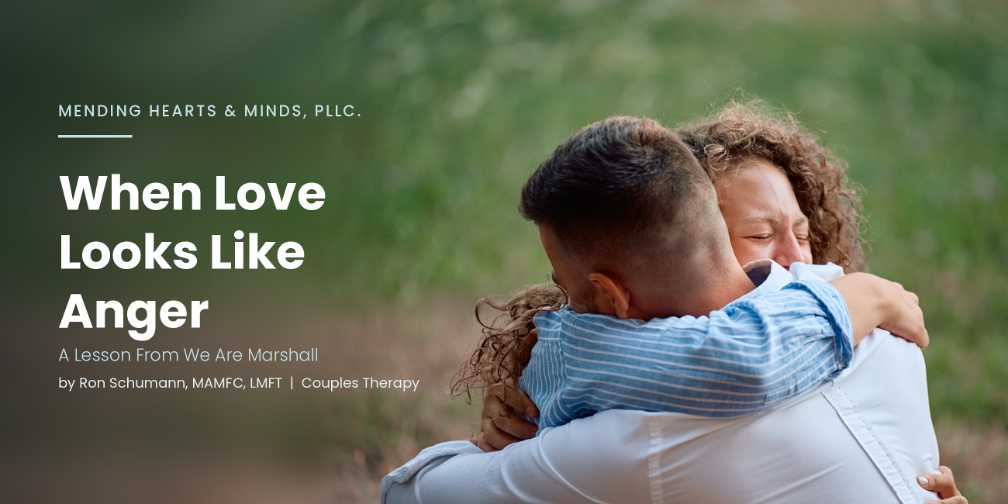
The thing is that she didn't run into his arms first. She hit him. Right in the chest. And then she collapsed into him, holding on like she'd never let go again.
If you've ever watched that scene and felt something catch in your throat, you already understand — on some level — exactly what I spend my days helping couples understand.
The punch was never about anger
In Emotionally Focused Therapy, we talk about primary and secondary emotions. The secondary emotion is the one that shows up first, the one you can see — in this case, you might believe she is angry. Fists on a chest.
But underneath that anger was something else entirely: terror, grief, and an absence so total that it had already started rearranging her life. The anger wasn't the real message. It was the messenger — loud, fast, and impossible to miss — for an emotion too big and too tender to say out loud in that moment: I thought I lost you. Don't you ever do that to me again. I need you.
We call this a protest response. It's not a character flaw. It's not “overreacting.” It's one of the oldest, most reliable signals in human relationships — wired into us long before we had language for attachment. When connection is threatened, we don't always reach out gently first. Sometimes we reach out with a fist, because the fear underneath is that loud.
Why this matters for the rest of us, in far less dramatic moments
Most of us will never live through anything like a plane crash. But almost every one of us has thrown a version of that punch — at a spouse who came home late without calling, at a partner who went quiet during a hard conversation, at someone we love who simply didn't answer the phone when we needed them to.
In the moment, it feels like the anger is the whole story. You made me wait. You scared me. You weren't there. But if you slow down — really slow down — underneath almost every one of those flare-ups is the same thing that put that wife's fists on her husband's chest: I need to know you're still with me.
This is especially true for men who've spent a lifetime being told that the only acceptable emotion in a crisis is control. Anger is often the one feeling that's been given full permission. It's the one that shows up when we don’t have words for fear, grief, and longing. That doesn't make the anger fake. It is really a bodyguard for something softer that never got taught how to speak for itself.
What to do with this
The next time you find yourself snapping at someone you love — or they snap at you — it's worth pausing long enough to ask a different question than the obvious one. Not “Why are they so upset?” but “What are they so afraid of losing?”
That question doesn't excuse cruelty, and it doesn't mean every angry moment is secretly romantic. But it does mean that the loudest emotion in the room is rarely the truest one. Somewhere underneath it is usually the same thing that drove a grieving wife into her husband's arms the second her fists were done doing their job: I love you. I need you close. Don't leave me again.
If you recognize yourself in this — if you've noticed that your closest relationships seem to bring out your sharpest reactions — that's not evidence something is wrong with you. It's often evidence of exactly how much that connection matters. Learning to hear the fear underneath the anger, in yourself and in the people you love, is some of the most important work a relationship can do. It's also work you don't have to figure out alone. Give us a call at 865-238-5696, or schedule a consultation by clicking here.
